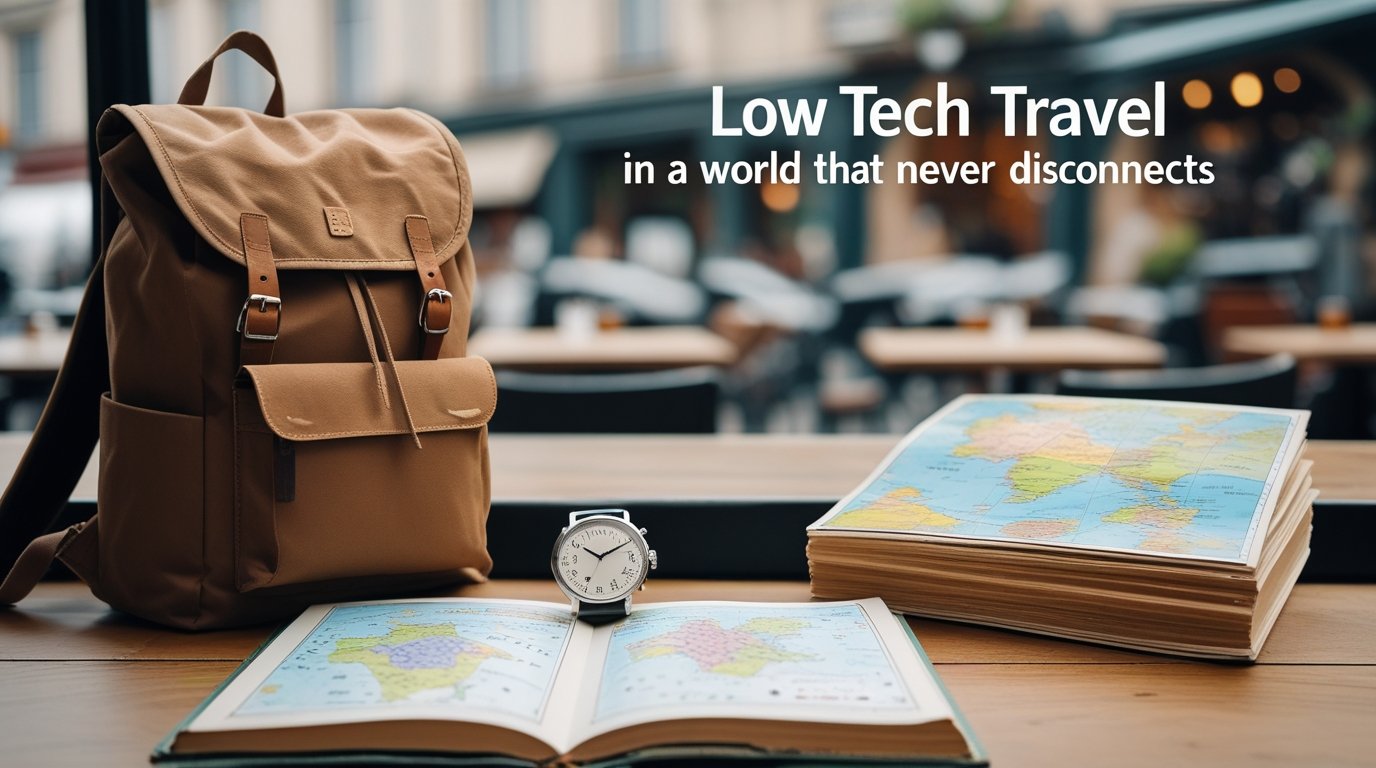
It all started when my phone died in a tiny French village with no Apple Store for forty miles. I had no map, no translation app, no way to call my Airbnb host. I had a small panic attack on a cobblestone street, followed by a wave of something else: freedom. That dead battery forced me to ask a human for directions, to actually look at the sun to guess the time, and to find my way using a paper map from the bakery. It was terrifying, then magical. In a world that screams “Stay connected!” I learned the joy of quietly disconnecting. Low-tech travel isn’t about being a hermit; it’s about rediscovering the trip itself.
Why Go Low-Tech? The Problem with Digital Crutches:
Think about how we travel now. We stare at Google Maps instead of the street. We listen to a podcast about a place instead of listening to the place itself. We take 200 photos to post later instead of looking with our own eyes for more than three seconds. Our phones become a barrier between us and the experience.
The “digital crutch” creates a weird anxiety. What if my battery dies? What if there’s no Wi-Fi? What if I get lost? We’re so scared of these things that we miss what’s right in front of us. Low-tech travel flips that fear. It says: Getting a little lost is the adventure. Not having an instant answer is how you discover something better.
What’s in My Bag (Besides a Phone on Airplane Mode):
I don’t throw my phone in a river. I just put it on airplane mode and bury it at the bottom of my bag for emergencies. Here’s what I actually use:
1. The Almighty Paper Map:
I get one from the tourist office or my hotel. You learn a city’s shape in a way a blue dot on a screen can’t teach you. You see how neighborhoods connect. You make wrong turns that lead to beautiful courtyards. Folding it is a skill. Getting a little lost is part of the plan.
2. A Physical Notebook & Pen:
This is my camera, my translator, and my diary. I sketch the funny sign above a shop. I write down phrases I hear. I note the directions a local gives me. I drew a map of how to get back to my hotel. The act of writing makes you remember. It’s slow, but that’s the point.
3. A Real Book:
A novel set in the country I’m visiting, or a guidebook. Reading a paper guidebook on a train feels intentional. You’re planning, not just scrolling. And a novel makes you look up and thoughtful, not like you’re checking work email.
4. A Disposable or Simple Film Camera:
This limits you to 24 or 36 shots. You have to really think: “Is this view worth one of my precious frames?” It makes you a better photographer. No filters, no instant review—just the anticipation of getting the film developed when you’re home.
5. A Basic Watch:
Not a smartwatch. Just a watch that tells time. It stops you from pulling out your phone (the gateway drug to scrolling) every five minutes.
How a Low-Tech Day Actually Unfolds:
Let me walk you through a day in Lisbon, done my way.
- Morning: I wake up and check my paper map, not my phone. I decide to walk to the Alfama district. I leave my phone in the hotel safe. I have my notebook, my map, and some cash. I get lost almost immediately. I ask an old man sitting outside a café for directions. He doesn’t speak English, but he draws the way in my notebook with my pen. I bought a pastel de nata from the bakery he pointed to. It’s the best one I have all trip.
- Afternoon: I sit in a square. I write in my notebook about the smell of salt and grilled fish, and the sound of the yellow trams squealing on the rails. I see a museum and go in. I read the placards on the wall instead of looking up the Wikipedia page. I take three photos with my film camera.
- Evening: I can’t check reviews for dinner. I walk until I see a place that’s busy with locals and smells amazing. I point at what the person next to me is eating. It’s delicious. I have no idea what it’s called. I drew a picture of it in my notebook. To get home, I follow my own hand-drawn map from the morning. It works.
The day felt long, full, and deeply mine. I wasn’t following a digital schedule. I was following my nose, my curiosity, and the advice of strangers.
The Challenges (And How to Laugh Them Off):
It’s not always perfect. You will get properly lost. You will order the wrong thing. You will miss a train because you misread the paper timetable.
The key is to see these not as disasters, but as the stories you’ll tell later. The time I got lost in Kyoto and ended up at a tiny family-run tea ceremony, I never would have found otherwise. The time I ordered “offal stew” in Zagreb, thinking it was beef. It was an experience! Low-tech travel requires a sense of humor and a bit of courage. The safety net is gone, but the net was also holding you down.
Re-Entering the Connected World:
Coming home is strange. You have a notebook full of scribbles and sketches, not 1,000 identical photos. You have a roll of film to develop. Your stories are about people and mistakes, not about perfect Instagram spots.
You realize how much mental space your phone usually takes up. That constant buzz is gone. You feel calmer. And you start to bring little bits of the low-tech life back home. Maybe you leave your phone at home for a Saturday walk. Maybe you get a paper map of your own city. The trip doesn’t end when you fly back; it changes how you see everything.
Low-tech travel reminds you that you have a brain that can solve problems, eyes that can see, and a voice that can ask for help. It puts the adventure back into travel, because when you’re not just following a blue dot, anything can happen.
The Simple Truth:
Going low-tech doesn’t mean you hate technology. It means you love travel enough not to let a screen get in its way. It’s about trading the stress of constant connection for the joy of real discovery. The world is more vivid, people are friendlier, and you feel more alive when you look up from your phone. Give it a try. Just make sure you know how to fold the map first.
FAQs:
1. What if I have a real emergency?
Carry your phone on airplane mode for true emergencies, along with a paper note of critical addresses and numbers.
2. Don’t you miss out on useful apps?
You learn to use the oldest, most reliable apps: asking people, reading signs, and observing your surroundings.
3. Is low-tech travel cheaper?
Often, yes—you’re not paying for constant data, and you make more spontaneous, local choices that aren’t on expensive tourist apps.
4. How do I navigate without GPS?
Use a paper map, learn basic landmark navigation, and don’t be afraid to ask locals for directions—it’s a great way to meet people.
5. What’s the hardest part?
The first few hours of “digital withdrawal,” where you’ll instinctively reach for your phone before remembering you’re choosing not to.
6. Can I do this if I don’t speak the language?
Absolutely; pointing, smiling, and using a physical phrasebook often leads to more genuine interactions than a sterile translation app.